
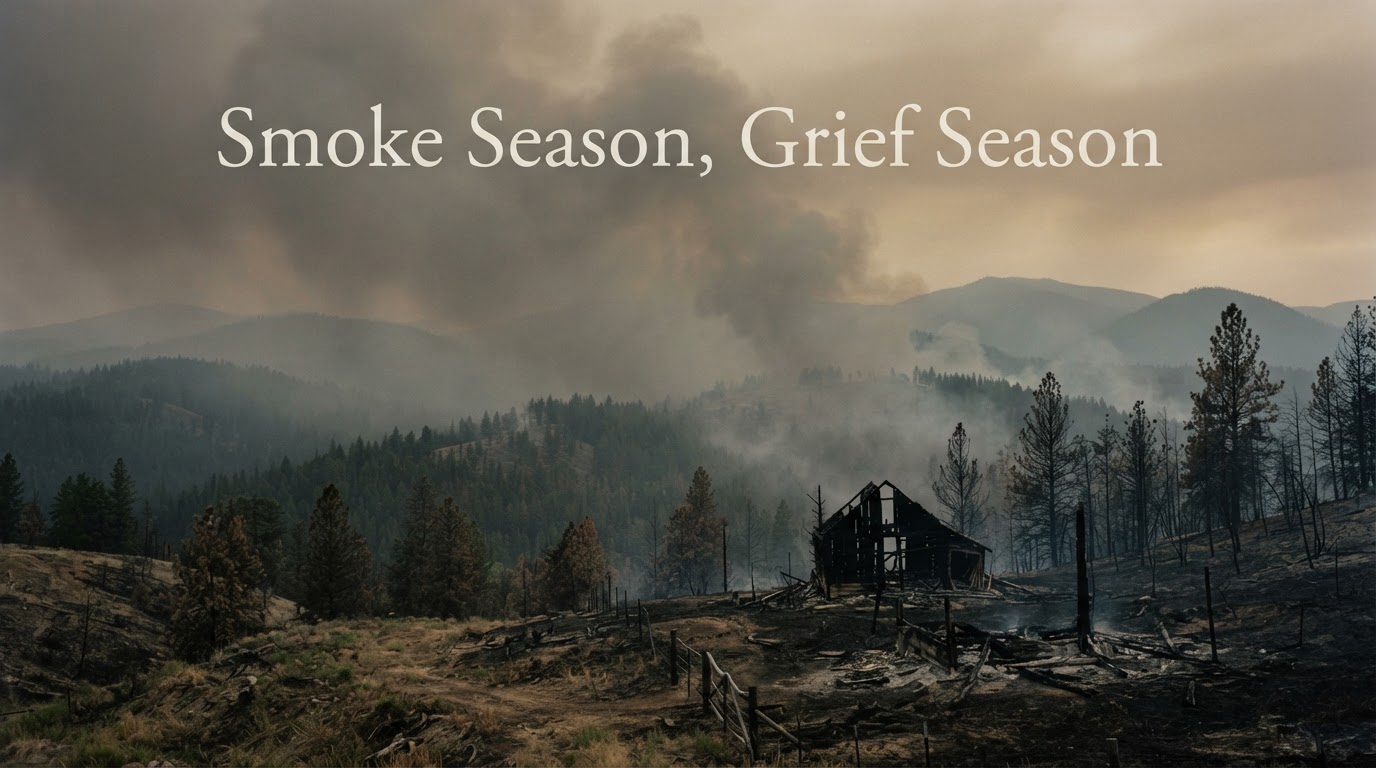
Wildfire Smoke, Grief and Stress: How to Support Your Body During Smoke Season
Geof and I have been driving to Spokane about once a week lately. We climb, hunt down one of the more interesting restaurants we can find, walk along the river or explore a part of the city we haven't spent much time in, then drive home in the dark.
We've joked about getting a second home there.
Somewhere along the way Spokane has started to feel a little bit like ours. We've made friends through the Spokane Mountaineers, gotten to know people we climb with, and built some small routines in a city that used to just be somewhere we drove through.
So watching wildfire tear through those communities this summer doesn't feel far away. We know people there now. We know the neighborhoods. We know what it feels like to watch the smoke move in and wonder what's going to be left when it's over.
A few years ago, we were the ones with bags by the door and a wildfire about a mile away.
You find out pretty quickly what you care about when you have to decide what comes with you. Geof went through the house and came out carrying the plants, our favorite dishes, the bedding and the good olive oil. We grabbed the bikes and the dogs.
Friends took all of us in. Dogs, houseplants, mismatched bowls and everything. That is not a small thing to ask of anybody.
We were gone for weeks and had no idea whether we'd have a house to come back to.
We did.
This summer has carried a different kind of loss.
Three people close to me have lost someone, along with losses closer to home that aren't mine to write about. Add the fires, the smoke, people losing homes and whole communities being disrupted, and I don't know that any of it fits neatly into separate events anymore.
It has just felt like a season.
A smoke season. A grief season.
And I've been thinking a lot about what happens in the body when those things overlap.
What do grief and chronic stress do to the body?
Chinese medicine associated grief with the lungs a very long time ago. The lungs belong to the metal element and are paired with the large intestine. Taking in. Letting go.
You can call that poetry if you want. I still find it interesting how often the body follows the metaphor.
Breathing can change when we're grieving or under prolonged stress. It gets higher in the chest. Shorter. We sigh more. Sometimes it feels hard to get a satisfying breath at all.
The gut often changes too.
In the early days of acute stress or grief, stools can become loose and urgent. The stress response affects motility throughout the digestive tract. A few weeks later, constipation may show up instead. You're drinking less water, eating differently, sleeping somewhere unfamiliar, moving less, ignoring the urge to go because your entire routine has disappeared.
I've had so many people come in worried that something new has gone wrong with their gut, and somewhere in the conversation I find out their dad died six weeks ago.
They hadn't connected the two.
Stress doesn't live separately from digestion, sleep, appetite or immune function. The body experiences all of it together.
How does wildfire smoke affect the body?
After a few days of wildfire smoke, you can taste it at the back of your throat. Everybody is tired, headachy and a little more irritable.
One of the primary concerns with wildfire smoke is PM2.5, fine particulate matter measuring 2.5 micrometers or smaller. These particles can travel deep into the lungs, reaching the alveoli. Exposure can trigger inflammation and oxidative stress that isn't necessarily confined to the respiratory tract.
Wildfire smoke can also contain compounds such as acrolein, formaldehyde and benzene. What else is present depends partly on what's burning. A wildfire moving through a forest isn't chemically identical to a fire moving through neighborhoods filled with building materials, vehicles, plastics, insulation and household chemicals.
Your body has antioxidant systems designed to deal with oxidative stress, including glutathione.
But those systems need raw materials.
And grief isn't exactly a low-demand state.
Sleep gets broken up. Appetite disappears. Stress hormones shift. People stop eating normally at exactly the time their bodies could use some extra support.
One of the first things I see disappear from a food journal during a loss is protein.
Toast survives. Coffee definitely survives. Sometimes wine increases. Eggs, fish, meat and beans somehow vanish because feeding yourself properly requires a bunch of small decisions, and decision-making can feel surprisingly hard when you're grieving.
So during wildfire smoke season, especially during an already difficult stretch of life, I get very basic.
How can you improve indoor air quality during wildfire smoke?
Don't worry about purifying the entire house first.
Start with the bedroom.
You're going to spend roughly eight hours there breathing whatever is in that room, so creating one cleaner-air space gives you a long stretch of reduced exposure every night.
Run a HEPA air purifier that's actually sized for the room. Look at the CADR, or Clean Air Delivery Rate, rather than assuming a small purifier will handle a large bedroom.
You can also build a Corsi-Rosenthal box with a box fan and MERV-13 furnace filters. They're inexpensive, ugly and remarkably good at moving filtered air.
Outside, an N95 respirator can reduce exposure to fine smoke particles when properly fitted. Cloth and surgical masks aren't designed to filter PM2.5 nearly as effectively.
In the car, use the recirculate setting when you're driving through smoke.
And maybe give the candles, incense and cast-iron steak searing a rest until the outdoor air improves. Indoor air pollution still counts.
One local wrinkle for those of us in North Idaho and Eastern Washington: don't automatically assume early morning is the best time to open the windows. During some smoke events, cooler nighttime conditions can allow smoke to settle near the ground.
Check your local hourly AQI before airing out the house.
Does hydration help during wildfire smoke?
Your respiratory tract has its own cleaning system. Mucus traps particles and tiny hair-like structures called cilia help move that material upward so it can be cleared.
Hydration helps keep respiratory secretions from becoming excessively thick.
August heat complicates things because you're also losing fluid and electrolytes through sweat. Plain water is useful, but if you're outside sweating for hours, sodium and potassium matter too.
A pinch of mineral salt in water works for some people. So does broth or a good electrolyte mix. Herbal tea counts toward fluid intake too.
What should you eat during wildfire smoke season?
I don't think smoke season requires an elaborate "detox diet."
I think it requires nutrients.
Broccoli sprouts and sulforaphane
Broccoli sprouts are one of my favorite foods during smoke season because sulforaphane has human research behind it in the context of airborne pollutants.*
Broccoli sprouts are especially concentrated, but broccoli, cabbage, arugula and radishes also provide glucosinolates used to produce compounds such as sulforaphane.
If you want a reliable supplemental source, I recommend BrocElite Plus — a stable, bioavailable sulforaphane supplement I keep in my own cabinet during smoke season. You can find it in my recommended supplements.
Vitamin C-rich foods
Then I think about vitamin C.
Peppers. Kiwi. Citrus. Strawberries. Broccoli.
Vitamin C is an important antioxidant and is found in the epithelial lining fluid of the respiratory tract, where antioxidant defenses are particularly relevant during exposure to pollutants.
Foods that support glutathione production
Glutathione is made inside the body from the amino acids cysteine, glycine and glutamate.
Cysteine availability is particularly important, which is one reason adequate protein matters.
Eggs, meat, poultry and fish provide amino acids used in glutathione production. Garlic, onions and cruciferous vegetables also contain sulfur compounds that make them useful additions during a high oxidative-stress period.
Add oily fish when you can: sardines, salmon, mackerel.
And eat color. Berries, herbs, red onion, dark greens, peppers.
Don't forget protein
Protein is the thing I care about most in practice.
Aim for roughly 25–30 grams at a meal. If you're grieving, evacuated, living with relatives or just barely holding things together, I do not care how glamorous the meal is.
Rotisserie chicken.
Canned salmon.
Cottage cheese.
Greek yogurt.
A protein shake.
Leftover hamburger eaten cold while standing in front of the refrigerator.
This is not the month for aspirational meal prep.
Just nourish.
What should you avoid when wildfire smoke is bad?
Alcohol is rough during a stretch like this. Alcohol metabolism affects glutathione, contributes to dehydration and tends to make the second half of sleep worse.
I also wouldn't do hard outdoor training when the AQI is high.
The harder you exercise, the more air you're moving through your respiratory system. That means potentially increasing your dose of wildfire smoke at the exact moment you're trying to reduce exposure.
Move the workout inside.
If you climb, go to the gym. If you run, use the treadmill or take a few days off.
And please don't decide August is the perfect time for a cleanse.
I understand the impulse. Summer gets chaotic, food gets weird, routines disappear and suddenly we want to make up for it by getting very strict.
A depleted body doesn't need a harder assignment.
October will still be there.
Smoke season is also a season to pull inward
We're heading toward that strange part of the year when the culture starts telling us to ramp everything back up.
School. Schedules. Programs. Plans. September.
But the natural world is moving the other direction.
The light is already shortening. Evenings cool down. Things begin drying out and going to seed. Historically, this was the time to gather what would keep, put things away and prepare for a quieter season.
I think our bodies notice before our calendars do.
So if you're feeling yourself pulling inward toward the end of August, I wouldn't immediately treat that as something to overcome.
Maybe put less on the calendar at night.
Eat warmer food as the weather turns.
Go to bed earlier.
Say no to a few September commitments now instead of waiting until you're exhausted enough to cancel them.
There is a lot we don't get to control. Fire makes that painfully obvious. So does loss.
But there are still small things.
Clean the air in the room where you sleep.
Drink enough water.
Eat some protein even when nothing sounds good.
Take your workout inside when the AQI is bad.
Go to bed earlier than you think you need to.
Make fewer demands of a body that's already carrying more than usual.
The smoke clears.
The rest usually takes longer.
Wildfire Smoke Support: The Short Version
If wildfire smoke is affecting your area, start with exposure rather than supplements: create a clean-air bedroom with appropriately sized HEPA filtration, check the AQI before opening windows, use an N95 outdoors when air quality is poor and recirculate air in the car. Stay hydrated, replace electrolytes when you're sweating heavily, eat enough protein and include foods rich in vitamin C, sulfur compounds, omega-3 fats and colorful plant antioxidants. Move strenuous exercise indoors when smoke levels are elevated. During periods of grief or prolonged stress, simplify food and routines rather than adding restrictive diets or aggressive cleanses.
Kensler et al., Cancer Prevention Research, 2014. In a randomized trial conducted in a heavily polluted region of China, adults consuming a broccoli-sprout beverage had increased urinary excretion of benzene and acrolein metabolites over the 12-week study period.
Kelly is a trained health practitioner at Dig Nutrition. This article is general education, not medical advice. People with asthma, COPD, cardiovascular disease, pregnancy, or other conditions that increase risk from wildfire smoke should follow individualized medical guidance during smoke events.
Free 3-Minute Assessment
Your energy pattern may offer a useful clue.
Take this free 3-minute assessment to see which pattern is most consistent with the timing and symptoms you've been noticing.
Take the Energy AssessmentReady to find out why?
If what you just read sounds familiar, a free discovery session is a good place to start. We'll look at what's going on, what's been tried, and whether functional testing makes sense for you.